Westford has a rich history in the granite industry. The earliest recorded quarrying started in 1826 on Oak Hill, near what is now the Fletcher Granite Company. The granite from this area is known for its distinctive clean blue-gray color, referred to as “Chelmsford Gray.” Early quarrying operations occurred before the advent of railroads, relying instead on horse-drawn carriages for transportation.
By the early twentieth century, the two primary areas for quarrying were Snake Meadow Hill in Graniteville and Oak Hill in Nabnasset. By 1911, nearly half of the active quarries in Westford were located on Snake Meadow Hill; however, operations there gradually declined by the late nineteenth century. Today, the only remaining quarry in town is located off Oak Hill and is owned by the Fletcher Granite Company, which was established by H.E. Fletcher in 1881. Fletcher’s Chelmsford Gray granite is used in various projects both within the town and nationwide
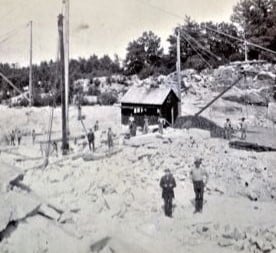
Palmer Granite
In 1847, Benjamin Palmer quarried the north side of Snake Meadow Hill in today’s Graniteville. Operations continued into the twentieth century. Essex Bituminous Concrete Corp of Peabody purchased the operation in the 1940s. Overall, operations wound down in the 1970s.

Fletcher Quarry
This photo of the Fletcher Quarry at Oak Hill was taken in 1949. According to the company’s website, Fletcher developed a joint-cutting saw for making a straight curb after quarrying in 1965, as well as later innovations such as a multi-diamond wire quarry and a saw for curbing slabs directly in the quarry in 2004. While Fletcher Granite Co. was established in 1881, nearly half of the active quarries in town were on Snake Meadow Hill by 1911. Today, Fletcher’s Oak Hill quarry represents the only remaining Westford operation.
The History of Graniteville, Massachusetts
Geoff Hall provides an insightful and thorough examination of the history of one of Westford’s villages.
Where Has All The Granite Gone?
In 2003, the Westford Historical Society published a calendar titled “Where Has All the Granite Gone?”
Researched and created by Marilyn Day, Westford Town Historian (2003), Slideshow edited by Alina Jeng, Westford Historical Society Intern (2020)
Timeline Set in Stone
19th Century
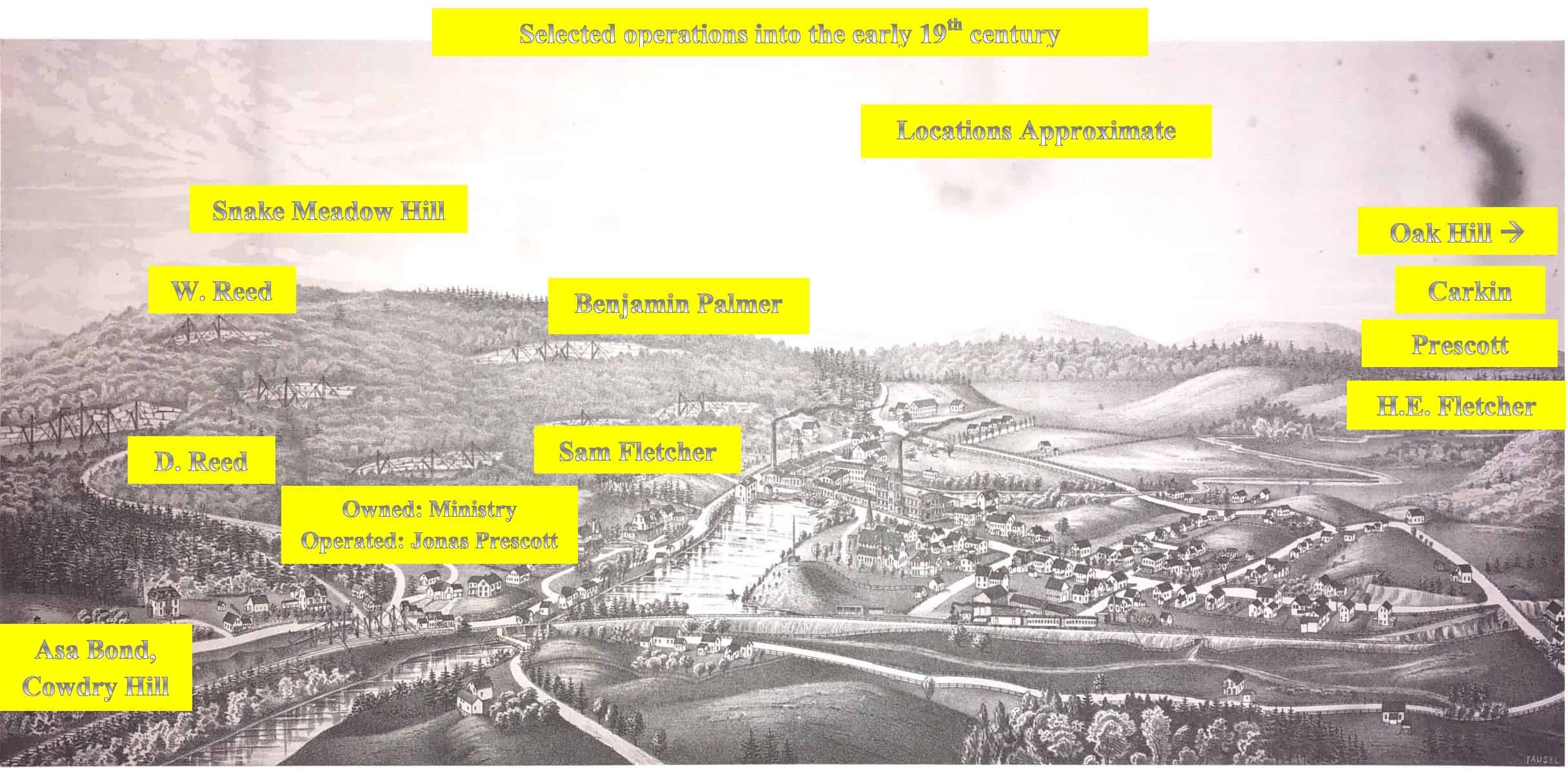
1826 – Quarrying began on the ledge on Oak Hill by Issac Carkin. After, Major Jesse Colburn and later George W. Merrill worked the ledge. Most of the stone was used for curbing and paving.
Ca. 1845—Hildreth quarry is active on the west side of Snake Meadow Hill. The stone was used for buildings and curbing.
1847 – In today’s Graniteville, Benjamin Palmer began quarrying on two sites on the north side of Snake Meadow Hill. Benjamin Parker also quarried “cobbles” there, and stone from Parker’s site was used for a bridge over Stony Brook and general curbing.
1848 – Samuel Fletcher of Groton opened more of the ledge on Snake Meadow Hill. Much of this stone was used for the Merrimack River dam in Lawrence, MA.
1853 – William Reed of Acton bought 61 acres on Snake Meadow Hill. He initially ran the business with his brother, David, who later divided the lot. William worked the top portion of the hill, while David worked the area near Cowdry Hill. Asa Bond briefly quarried Cowdry Hill before moving to Concord, NH. The Snake Meadow Hill Quarries supplied much of the granite for the state prison in Concord, MA, and existed into the 20th century.
1860 – H.N. Fletcher quarry opens on the south side of Snake Meadow Hill. The stone was used for buildings and curbing.
1880 – Wright quarry opens on the east side of Snake Meadow Hill. The stone was used for curbing.
1881—Herbert Ellery “Hobbie” Fletcher (1862-1956) opened the quarry, which is still operated today as “Fletcher Granite Co.” on the border to Chelmsford, near Oak Hill. The Chelmsford Gray continues to be used for buildings, bridges, curbing, and paving. This stone is found across the country in places such as Quincy Market in Boston, the Federal Building in Boston, and the columns of the Treasury Building in Washington, DC.
1899—Peterson Quarry opens on Oak Hill near H.E. Fletcher. Stone is used for trimmings, steps, sills, and curbing.
20th Century
1905 – Perley Carkin Quarry opens on Oak Hill near H.E. Fletcher. The stone was used for curbing, paving, and trimmings.
1906 – Couture quarry opens on the west side of Snake Meadow Hill. The stone was used for curbing.
1908 – Town approved funds, up to $40, for a block of granite from Herbert V. Fletcher’s Quarry to be used by Provincetown for the Pilgrim Monument. This quarry closed in 1940 when there was no more granite.
1909 – Cartwright opens a dormant quarry on Oak Hill near H.E. Fletcher. The stone was used for curbing.
1910—Morris and Luke’s quarry opened on Oak Hill near the old Carkin quarry, and a New Carkin quarry opened, also on Oak Hill. The stone from these sites was used for curbing and paving.
1911 – 13 active quarries in town, six located on Snake Meadow Hill.
1922—George Morris began quarrying land on Forest Rd near Flushing Pond. By 1973, Velmos H. Stone of N. Chelmsford owned this land.
1923 – Other active quarries on Oak Hill included Prescott Quarry (operated by Arthur Decarteret and Baker Lot Quarry (operated by Thomas LeMasurier).
1930—Palmer and Sons Granite was the oldest family-operated quarry in New England. 1940—The quarry started by Samuel Fletcher closed.
1940s—Palmer Granite transferred operations to the Essex Bituminous Concrete Corp of Peabody, which remained in operation at least partially into the 1970s.
1955 – H.E. Fletcher Co. operations of a neighboring quarry then owned by Clarence DeCartaret.
1985 – Fletcher Granite Co. sells to Australian Pioneer International, Ltd.
21st Century
2007– Fletcher Granite Co. briefly shut down due to financial issues and later sold.
2019 – Now the only active granite quarry in town, Fletcher Granite Co. quarries and sells 17 types of granite from across New England, including Westford’s Chelmsford Gray.