Museum Musings, January 9, 2026
By Robert W. Oliphant
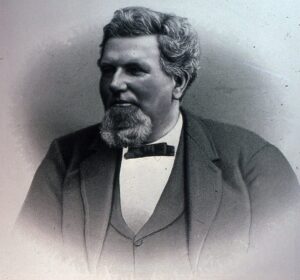 We might think of Charles Grandison Sargent as Westford’s Thomas Alva Edison. He lived a generation before Edison, but like Edison, he had that inventive genius that brought wealth to both men. Named after Samuel Richardson’s 18th-century fictional character, Charles Grandison, who personified Richardson’s views of a true Christian gentleman, Mr. Sargent lived up to his namesake.
Charles G. Sargent was born in Hillsboro, N.H., on July 17, 1819, the son of a tailor and the grandson of a Revolutionary War veteran. Charles was educated in the public schools of Hillsboro until age 14 when he was apprenticed to a cabinetmaker and then to a clockmaker. The third of eight children, Charles was closest to his older brother, Frederick W. When Fred, a tailor, moved to Lowell around 1840, Charles joined him. There Charles was apprenticed as a machinist at the Lowell Machine Shop (where he met Elias Howe, inventor of the sewing machine). He next worked for his brother-in-law, William Calvert, at Eagle Mills in West Chelmsford. Returning to Lowell he was the overseer in the Lowell Manufacturing Co. for about eight years. He then went into two short-lived machine shop businesses before starting a firm to manufacture worsted yarns on Broadway St., Lowell.
Charles’ mechanical genius was aptly described in his obituary in the Vox Populi, of July 16, 1878. “While in the employ of the Lowell Manufacturing Co. … he brought out, under his own invention, a burring machine, which proved a most valuable device for use in the textile industry. Thereafter he devoted most of his time, energy and inventive talent to the invention and manufacture of machinery, and especially machines for use in the textile trade. His name became one of the famous surnames in the industrial world of his time and the devices that he brought out aided very materially in increasing the volume of production and the quality of the textiles in all the mills where the Sargent machines were installed. He was wholly in love with his work, a natural machinist, and ever keenly interested in working about some mechanical problem, solving it by some device of his own invention.”
In 1842 Charles married Harriet Reed, a Westford girl. Perhaps he learned about the old mills along the Stony Brook in what was then called Stone Quarry on his courting visits to Westford. At any rate, in 1854 Charles teamed with Francis Calvert to buy the old saw and grist mill in Stone Quarry where they formed the firm of Calvert & Sargent to manufacture machinery for cotton and woolen mills. Charles spent the rest of his life in this business.
Charles moved his family from Lowell to Stone Quarry (changed to Graniteville at Charles’ recommendation) in 1855 and in the late 1860s he built the large home at 25 North Main St. Charles and Harriet had five children. Their oldest and youngest, sons Frederick and Allan Cameron, would later join Charles’ firm. Their oldest daughter Harriet Rebecca “Hattie” married Rev. Miner H. A. Evans, the first (and fourth) pastor of the Methodist Episcopal Church at Graniteville, now the United Methodist Church of Westford. Daughter Rebecca Ann married Dr. William R. Jones and died at the young age of 35 years, and daughter Lois Maria died in infancy.
In 1855 Charles teamed with John W. P. Abbot and his son, John W. Abbot, to form Abbot Worsted Company in Graniteville. Two years later he sold his interest in this firm to Allan Cameron, newly arrived from Scotland, who replaced Charles as the chief engineer in the firm.
In 1858 the Calvert & Sargent buildings burned to the ground. The firm moved to Lowell while the buildings were rebuilt. In 1862 Charles bought out Calvert, sold a part interest in the firm to his son Frederick, and renamed the firm C. G. Sargent & Son. The Sargent & Son machine shop building on Broadway St. in Graniteville was completed in 1878. In 1882, after Charles’ death, Fred brought his brother, Allan Cameron Sargent, into the firm which became C. G. Sargent’s Sons. In 1874 Charles partnered with Rev. Miner Evans to start the Chauncy Hosiery Mill in Graniteville. This only lasted a couple of years as Rev. Evans returned to the ministry in 1876 when he became pastor of the Methodist Episcopal Church at Graniteville for the second time.
Charles G. Sargent was instrumental in establishing this church. Rev. Miner H. A. Evans came to Graniteville in the summer of 1869, roomed in the Sargent home, and preached God’s word to the villagers, who overflowed the District 10 school house to hear him. With the blessings of the New England Conference of the Methodist Episcopal Church, Rev. Evans formed the new church and collected subscriptions for a church building. At the first Quarterly Conference held in August 1869 Charles G. Sargent was elected chairman of the board of trustees, a position he held until his death. He donated the land for the church in 1869 and for the parsonage in 1872. He contributed $2,000 towards construction of the building, which was completed in March 1871 at a cost of $10,786; he contributed an additional $500 in 1872. On January 31, 1872, he gave his daughter, Hattie, in marriage to Rev. Evans at a large wedding performed by Rev. David H. Ela, Charles’ brother-in-law, in the new church.
Mr. Sargent was a community leader in both Lowell and Westford. He was a director of the Prescott National Bank and a trustee and vice president of the Central Savings Bank in Lowell. He was also a director of the Nashua & Acton Railroad (Red Line). Charles was a long-time member of Pentucket Masonic Lodge in Lowell. His children graduated from Westford Academy, and in 1874 he was elected a trustee of the Academy.
The Westford tax lists record Mr. Sargent’s rise to prosperity. The value of his estate in 1860, two years after his firm burned to the ground, was only $200. His firm prospered from the high demand for textiles during the Civil War, and by 1875 his estate was valued at $51,509, the largest estate on the town’s 1875 tax list.
Charles G. Sargent suffered from Bright’s disease and died July 16, 1878, a day short of his 59th birthday, at Juniper Point, summer home to many Lowell families, in Salem, Mass. His funeral was held in the Methodist Church at Graniteville, and was largely attended, with many people arriving by train from Lowell. His body was taken by train back to Lowell for burial in the family plot in Lowell Cemetery.
What more might Mr. Sargent have done for Westford had he lived out his life to a ripe old age?
This article is based on an illustrated talk given by Dr. Oliphant at the Westford Museum on September 11, 2005, at the presentation of the restored C. G. Sargent Estate Map of Graniteville, kindly donated to the Museum by Jane Hughes and Gary Oravetz who are renovating the Allan Cameron Sargent house where the map was found.