Apple Grower, Innovator, Town Official
By James Van Bever
Ben Drew was born on July 27, 1910, in Greenwich, Connecticut, to George Albert and Rachel Bancroft (Brooks) Drew. The young Drew graduated from high school in Greenwich and later moved to Belmont, Massachusetts. Upon graduating from high school, Ben entered Dartmouth College, where he majored in economics. He graduated from Dartmouth in 1932.
Ben’s father George A. Drew, who was a native of Westford and a Westford Academy graduate, had graduated from Massachusetts Agricultural College in 1897. George, who already owned the Read farmland at 164 Main Street in Westford had run a fruit farm in Connecticut for 13 years. At first, the Read land had been a dairy farm, but Mr. Drew converted it to a fruit farm growing apples and pears.
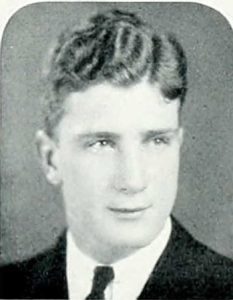
Having majored in economics in college, Ben felt he could apply his economics study to modern farming. Thus, “the young college graduate rolled up his sleeves upon graduating and learned about horticulture from his dad.” Thirteen years later, Ben Drew took over the management and operation of the 175-acre farm in Westford. He also operated a fruit stand on Boston Road that sold apples, cider, and peaches. During apple season, the stand had weekday hours of 10 to 8 and 10 to 6 on Saturdays.
Aside from his successful fruit business, Ben Drew was also active in town affairs. He was chosen as Westford’s Town Moderator in 1943 and served in that role until 1968. He also served as president of the Westford Taxpayers Association and was an active member of the First Church United in Westford.
Ben Drew’s view on apple farming was that it “is less an agricultural enterprise than an industry.” Although Drew’s farm was large by local standards, it could not compete with four-hundred-acre farms in other New England states “where taxes, soil conditions are much better adapted to the growing than is the stony, acidic, and expensive Massachusetts.”
To overcome these obstacles, Drew employed a new system of storing apples called the Controlled Atmosphere. Ben learned about this system on a 1954 trip to England. The system involved putting the apples to sleep in the fall by combining refrigeration with a controlled atmosphere so that the fruit would not ripen until spring when there was a demand for fresh apples.
Mr. Drew’s innovative approach to apple growing did not go unnoticed by the U.S. Government. In 1960, he was chosen as one of five representatives from West Virginia, Washington, Oregon, and California to represent the American fruit growers in Europe. Along with the State Department and the Department of Agriculture, this American team tried to “break through the wall which European countries had erected to keep out American fruit.”
The group spent two months in Europe, visiting the United Kingdom and then entering the heart of Europe, visiting France, Belgium, Holland, Germany, and the northern Scandinavian countries. Working with American embassies in these nations, they met with European government officials and representatives to break down these barriers.
Drew and his team realized that they could not compete with the Europeans in the general market because the cost of producing and shipping was too expensive. But the Americans felt they could “offer specialized high-quality apples and pears that would offer variety in a bountiful season and perhaps support the market in those years when crop failures meant empty shelves.”
In Ben’s later years of fruit farming, he became interested in the propagation of antique apples in “Old Sturbridge Village.” Mr. Drew knew how important the apple was in colonial times since the fruit “could be cooked, the juices pressed for cider and vinegar and could be stored in cool cellars. Dried apples were especially useful, kept well and were a source of income.”
As Ben became older, he had thoughts of moving to Vermont where he could own a smaller farm with less acreage and continue experiments with antique apples. He found such an abandoned farm in Vershire, Vermont. In addition to farming in Vershire, Ben became involved in town affairs there, serving as a town selectman and Justice of the Peace.
The time came for Ben to sell his property, 66 and 70 Boston Road and 164 Main Street, which included houses, barns, a fruit stand, and acres and acres of apple orchards. Ben’s grandfather, George Drew, had built the farmhouse at 70 Boston Road in 1865. Ben sold that property to Brad Emerson, and Brad relocated his Real Estate Office to the barn. Keith Bohne purchased the fruit stand at 66 Boston Road and the surrounding land.
Although there was a temptation to sell the 164 Main Street property to the highest bidder for house lots, Ben’s passion for preserving open space and his ancestral lands led him to sell the acreage to the Mormon Church. The church intended to continue the same farming practices for the benefit of its members.
Although the Mormon church had hoped to continue fruit farming for the benefit of its members, this did not prove to be successful. The church depended on unskilled volunteers from “various states to cultivate, spray, prune and collect fruit, but the use of inexperienced labor and management took its toll.” The failure of the volunteer program resulted in the land being re-sold to the Anderson family.
Despite moving to Vermont, Ben continued to be involved in his former fruit farm and in town affairs. He would visit Westford once a week to visit old friends and to aid the farm manager. Mr. Drew also made a gift to the town of twenty acres in the Crown Road area.
On September 6, 1989, Mr. Drew made his weekly visit to Westford and did his usual walk through his old orchards. He had picked some fruit and then returned to his home in Vermont. He died the same day. He was survived by his wife, Sara, and his children, Sara, Benjamin Jr., Leslie, Eleanor, and George. Benjamin Warren Drew is buried at the Fairview Cemetery in Westford.


Sources:
“Ben Drew Elected Taxpayers Head: Notes of Interest,” Lowell Sun, March 12. 1940, p. 33.
Ibid. “George A. Drew Dies in Belmont, November 26, 1943, p. 2.
Ibid. “Drew’s Fruit Farm”, August 16, 1949, p. 8.
Ibid. “It’s Farming, and it is Industry also,” by Russell Lynch, October 7, 1956, p. 1.
Ibid. “Nashoba Grower Now Controls Atmosphere to Keep Farm Fruit Fresh, by Sally Logan, March 22, 1959, p. 46.
Ibid. “European Countries and How they Protect Fruit Markets, by Gerard Vincent, July 31, 1960, p. 9.
Ibid. “Westford Orchardist Reports on European Fruit Industry” by Gerard Vincent,” August 1, 1960, p. 9.
Westford Eagle, November 13, 1975, p. 1.
Ibid. Benjamin Drew, Apple Grower, Former Moderator, dies at 79, Westford Eagle, 14 Sept. 1989, p. 1
Benjamin Drew, Apple Grower, Former Moderator, dies at 79, Westford Eagle, 14 Sept. 1989, p. 2